
Journaling for Anxiety: How Writing Calms a Racing Mind
Updated 2026-06-12
You lie awake. The to-do list replays. The conversation you handled badly. The uncertain thing you cannot stop rehearsing. If you have ever been caught in that loop at 2am, you already understand what anxiety feels like from the inside: a mind trying urgently to solve problems that have no solution right now. Journaling will not make those problems disappear. But there is good evidence that writing can change how your nervous system holds them, at least a little.
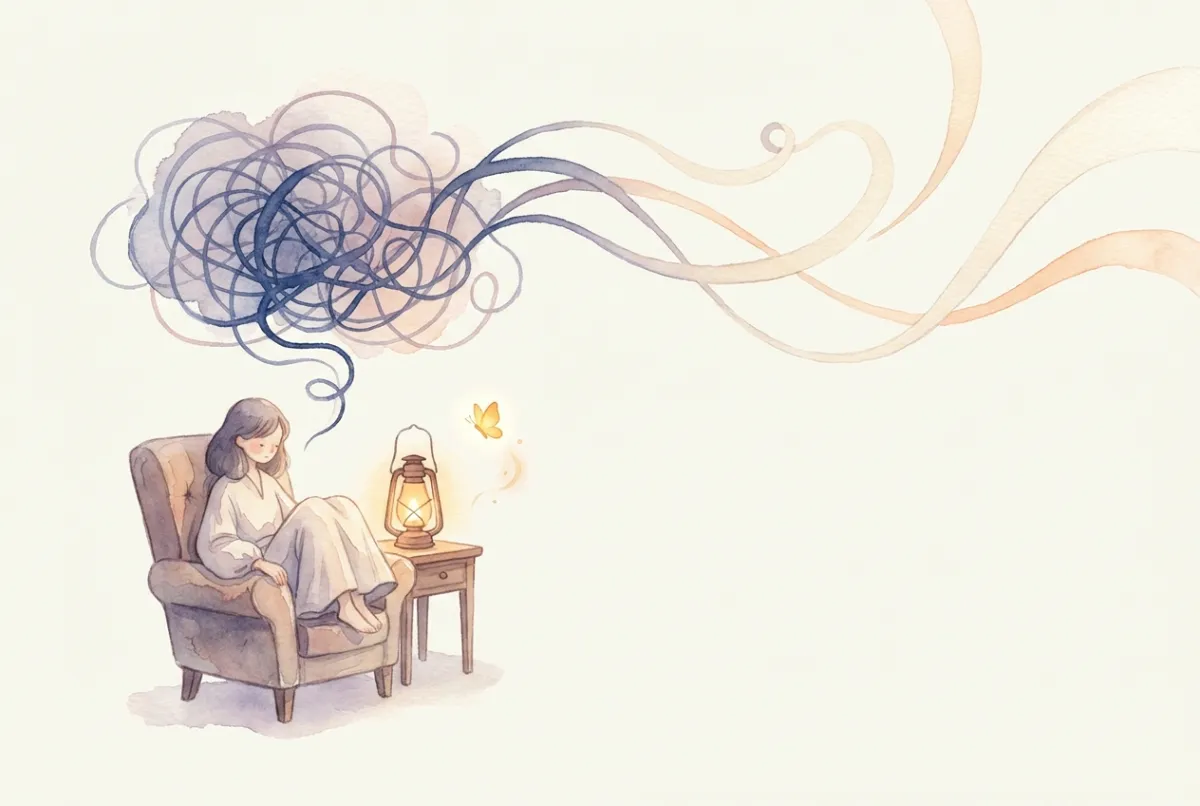
Why anxiety keeps you stuck in your head
Anxiety is not irrational. It is the threat-detection system working overtime, scanning for danger even when the danger is abstract or distant. The problem is that this system runs on loops. The same worry replays because the brain's job is to keep the alarm active until the threat is resolved, and an anxious thought rarely has a clean resolution.
Writing interrupts that loop. Not because it magically fixes the problem, but because it moves the experience from inside your head onto something external. The thought is no longer a loop running in the background, using up attention. It is words on a page, something you can look at instead of something that is happening to you. That small shift in relationship to the thought is part of what makes writing useful.
What neuroscience says about naming a feeling
Neuroscientist Matthew Lieberman and colleagues ran a series of experiments asking people to label their emotional states while viewing disturbing images. They found that naming an emotion was associated with reduced activity in the amygdala, the region responsible for processing emotional threat. When participants put a feeling into words, the brain's threat response quieted. The authors described the mechanism as working through the prefrontal cortex, the region involved in regulation, which appeared to modulate the amygdala's response.
This does not mean that writing your feelings will erase anxiety. The effect appeared in lab conditions, and everyday life is messier. But it does suggest that there is something meaningful happening when you try to name what you are feeling, rather than just feeling it.
This is the difference between "I feel terrible" and "I feel a tight, nervous dread about the presentation on Friday." Specificity matters. The more precisely you can name a feeling, the better positioned your nervous system is to begin settling around it.
What research on expressive writing actually shows
A comprehensive meta-analysis by Joanne Frattaroli reviewed 146 randomized controlled studies on expressive writing and found a small but consistent association with improved psychological and physical outcomes. The average effect size was modest and varied considerably depending on the person and context. But across a wide range of study designs, the pattern held: writing about emotional experiences was associated with benefit more often than not.
More recently, a 12-week randomized trial by Joshua Smyth and colleagues found that a web-based positive affect journaling practice was associated with lower anxiety and reduced psychological distress among medical patients dealing with elevated stress, compared to a control group. The participants wrote about positive experiences and their meaning rather than focusing exclusively on the stressful things. Even that gentler form of journaling showed a measurable difference.
Neither study promises that writing will solve your anxiety. What they suggest is that for many people, regular writing is associated with a small but real shift, and small shifts tend to compound over time.
The vocabulary gap: why "I feel anxious" is not specific enough
Research by Vera Vine, Ryan Boyd, and James Pennebaker, analyzing large-scale natural language data, found an association between emotional vocabulary and wellbeing outcomes. The direction of causality is correlational, not proven, but the pattern is consistent: the words we reach for when describing what we feel are not neutral.
When you write "I feel anxious," the word is doing the least possible work. Anxious is a category, not a description. Underneath anxiety, there are usually several distinct things:
- Dread: something specific feels like it is coming
- Inadequacy: a worry that you are not enough for what is being asked of you
- Uncertainty: you do not know what is going to happen and cannot stand not knowing
- Shame: the anxiety that people will see through you
Getting specific is not just an exercise in vocabulary. It is what helps the brain begin to distinguish between types of threats, and sometimes to recognize that the thing it is treating as danger is something it can actually hold.
How to journal when anxiety has already taken over
You do not need to journal well. You do not need to write coherently or arrive at any conclusion. These three approaches tend to work even mid-spiral:
Brain dump first. Set a timer for five minutes and write everything that is in your head without stopping. Not to solve any of it, just to empty it. When thoughts are on paper, they take up less space in the background and leave more room to breathe.
Lead with the body. Start with the physical: where in your body does the anxiety live right now? A tight chest? Shallow breath? Heavy shoulders? Writing toward physical sensation often unlocks the feeling underneath it faster than trying to think your way to an emotion.
Ask one question. "What am I most afraid of right now?" Write the first thing that comes up, even if it sounds small or embarrassing. Then ask yourself: "Is there anything I can do about this today?" Not to fix everything at once, just to see what is actually in your control and what is not.
Journaling does not require resolution. The act of writing is not the destination.
How an AI companion deepens all of this
The hardest part of journaling for anxiety is often the blank page. Your mind is racing, but when you sit down to write, you do not know where to start. You write a few words and stop.
Murror was built for that specific moment. Each day, a mood check-in asks you to choose three feelings that are present right now, giving your nervous system the first small act of naming before you have written anything. From there, you write a private journal entry, and a caring AI companion reads what you have shared and reflects it back. Sometimes it offers more precise language for what you are feeling. Sometimes it asks a gentle question that helps you go one layer deeper.
Your entries stay encrypted and private. Nothing is shared unless you choose to. If there is someone in your life you trust, you can optionally share specific moments through Moments to Care, which gives them a glimpse of how you are feeling without requiring you to explain everything in real time.
Murror is not a substitute for therapy or for the people who know you. It is a reflective companion for the in-between moments: the 2am spirals and the Tuesday afternoon heaviness that you would not normally say out loud. Not as a way to avoid those conversations, but as a way to understand yourself well enough to begin them.
Starting a journaling practice when you are anxious does not require the right notebook or the right mood or a clear idea of what you want to say. It only requires a few minutes and a willingness to put words to what is already there. Some nights that will not feel like enough. But even the smallest act of naming, of placing a feeling outside your head instead of circling inside it, is something. You can start there.
Frequently asked questions
Can journaling really help with anxiety?
Research suggests it can. A meta-analysis of 146 randomized studies found expressive writing was associated with modest improvements in psychological wellbeing. The key is writing about your feelings, not just events.
How long should I journal when I feel anxious?
Even 5-10 minutes can be enough. In studies, brief regular writing sessions were associated with meaningful benefits over time. You do not need to write for hours to notice a difference.
What do I write about when I feel anxious?
Start with what you notice in your body, then name the specific feeling as precisely as you can. Writing 'I feel dread about tomorrow's meeting' is more useful than writing 'I feel bad.' Specificity helps your nervous system settle.
When should I seek help instead of journaling?
Journaling is a supportive tool, not a treatment. If anxiety is interfering with daily life, sleep, or relationships, talking with a mental health professional is the recommended next step.